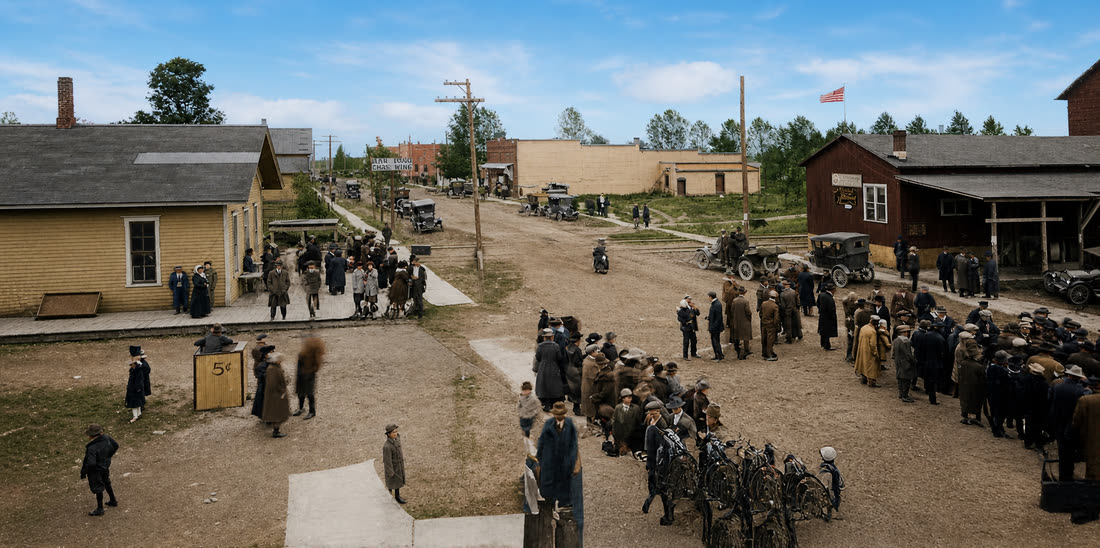
Officially, on February 21, 1907,
the settlement of Whittemore, Michigan was incorporated into fourth-class city-hood
when Legislative Act #352 was signed
into law by Republican Governor Fred Malthy Warner.
Many motives directed Whittemore
residents to seek incorporation as a city.
Firsthand, as the population of the settlement increased by leaps and
bounds, citizens desired for some type of formal organization to insure control
over their domain. Officially,
Whittemore had never been legally organized as a village, and had been
operating under the auspices of Burleigh Township.
The building of roads and bridges
became the second reason for incorporating.
Supposedly, as sources have dictated, the city residents felt that
Burleigh Township should pay for the costly construction of the several bridges
that surrounded Whittemore in all directions within the township. Thus, if Whittemore was incorporated as a
city, consequently the township taxpayers would provide the city residents with
the means to leave town.
Thirdly, because the population was
declining in the major settlements on the Lake Huron shoreline of Iosco County,
the county Board of Supervisors was weakening due to lack of representation. Meanwhile, Burleigh Township was growing
faster than any other area of the county, according to population surveys. The incorporation of Whittemore as a city
would provide the southwest corner of the county with additional political
clout at the county level.
After being properly incorporated,
the citizen’s caucuses and city conventions that followed to nominate aspiring
city officials evidently created some stir in the community. Ward #1, constituting the southern part of
the city, met at the old meat market opposite the railroad depot, and was
predominantly Democratic. While Ward #2,
located north of the railroad bed, met at Bullock and Horr’s Hall, and was
mainly Republican. Legend reports that
the political party interests of a person could be determined at election time,
especially if one moved into or relocated into a particular ward of the city.
In 1907, when Whittemore became a
city, the white pine lumbering era had passed andthe hemlock and hardwood
harvest, along with the mighty railroad days, were in full swing. Agriculture became the area’s predominant
livelihood, as fertile, reasonably-priced farmland held promise for those
desiring to own a farm. After clearing
away stumps and remnants of the white pine harvest, those with the desire to
farm took to the soil without hesitation.
Lumbermen and land barons were now anxious to part with the property
that once nourished their lumber endeavors.
In May of 1907 ground was broken for
Schroyer and Wismer’s new livery barn and community hall building. This 40 by 70 feet, two-story building became
a famous landmark in the city, and was eventually labeled as the Roll-Inn. Over the years, until a fire claimed the
building in 1963, this structure had served as a livery stable, roller skating rink,
dance hall, basketball court, restaurant, tavern, gathering place, and the
primary community building in the city.
This famous landmark stood where the Sportsman’s Bar is located today.
During July of 1907, the Michigan
Cereal Company of Port Huron became the owners of property along the railroad
tracks in Whittemore. Within days,
ground was broken for a new building, 60 by 40 feet structure became known as
the Whittemore Elevator Company. In its
early days, local people sorted beans and other small grains. This business provided employment for many
area residents. Part of the original
elevator remains today across Bullock Street from the current post office.
In August of 1907, the Iosco County
Bank erected a branch facility in Whittemore.
This 20 by 40 foot brick building was handsomely finished and promised
to be among the most complete and artistic banking offices in the state. The foundation of this building still is
evident in the parking lot on the south side of the Whittemore Hotel.
In the fall of 1906, local men
constructed a new school. The doors of
this educational facility opened to students on the Tuesday after Labor Day in
1907. Professor H. S. Lisle served as
principal, with Miss Florence Schroyer as assistant and Miss Maud Green in
charge of the primary room.
The population in Whittemore and
Burleigh Township began to feverishly boom in the mid-1900s. By 1904, Burleigh Township had 828 residents,
an increase of nearly 100 people from just four years earlier. Whittemore boasted 500 residents, not much
different from the population of 2007, when the city celebrated its centennial
year.
← Back to all histories