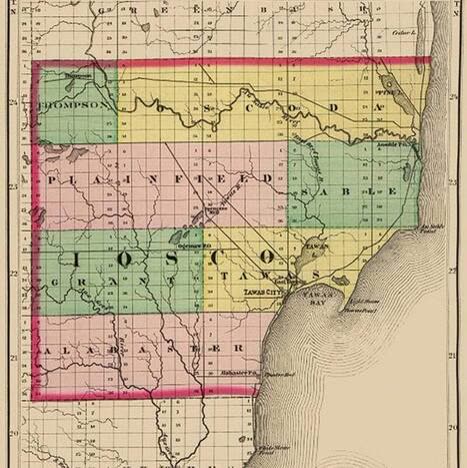
History of the Former Thompson Township, Iosco County, Michigan
1860–1880: Lumber Frontier and the Birth of a Township
The story of Thompson Township begins during the height of Michigan’s lumber boom, when Iosco County transformed almost overnight from wilderness to one of the most active timber regions in the Great Lakes. Originally carved from Au Sable Township, Thompson Township emerged in the early 1870s as lumber companies pushed inland from the Au Sable River corridor. The township’s dense stands of white pine made it valuable, but unlike the shoreline mill towns of Oscoda and Au Sable, Thompson developed as an interior logging and transport district. Temporary logging camps dominated the landscape.
Winter logging operations cut timber that was hauled by sled to river drives or early rail spurs. The land was rough, heavily forested, and constantly shifting as timber companies moved operations. The township’s creation reflects the rapid administrative changes required to manage population growth during the lumber era—many such townships were formed quickly, and some, like Thompson, would not endure.
1880–1900: Railroads, Community Growth, and Peak Activity
By the 1880s, Thompson Township reached its peak importance. The arrival of logging railroads—often referred to locally as the “Thompson Railroad”—transformed the area from isolated camps into a functioning community.
A small but vibrant settlement developed, likely centered along these rail lines and logging routes. By the turn of the century, the township included multiple one-room school districts, a general store and boarding house, a township hall, churches, saloons, a hotel, a small hospital, several doctors, and a practicing midwife.
This was not a large town by any measure, but it was remarkably complete for a frontier community, reflecting a stable population tied to the timber industry. Local timber contractors, camp foremen, railroad operators, and merchants supplied both workers and settlers. The township also became known for excursions to natural features such as “Big Springs,” suggesting early recreational use alongside industry.
1900–1920: Collapse of Lumber and Rapid Decline
The early 20th century brought a dramatic shift. As the great white pine forests were exhausted, the economic foundation of Thompson Township collapsed. Logging companies moved on. Rail lines were abandoned or dismantled. Stores, hotels, and boarding houses closed or relocated. Catastrophic regional events such as the 1911 fires devastated nearby communities, accelerating depopulation across inland Iosco County.
Unlike more resilient communities such as East Tawas or Tawas City, Thompson Township lacked a diversified economy, a permanent transportation hub, and access to Lake Huron shipping. Without these, it could not survive the end of the lumber era. By the 1910s, the township had entered rapid decline, with families leaving and institutions closing.
1920–1940: Dissolution and Absorption into Neighboring Townships
By the 1920s, Thompson Township had effectively ceased to function as a viable civil unit. Population loss and economic collapse led to its official dissolution, and its lands were absorbed back into surrounding jurisdictions, primarily Au Sable Township and neighboring areas. This fate was not unique; across northern Michigan, several boomtown townships disappeared after the lumber era ended.
What remained included scattered farm attempts on cutover land, abandoned foundations and camp sites, overgrown railroad grades, and small family cemeteries. The landscape began returning to forest, now dominated by second-growth species rather than the towering white pine of earlier decades.
1940–1960: Memory and Landscape Reclamation
By mid-century, Thompson Township existed only in memory and in historical records. The land that once supported logging camps and a modest community became forested tracts, hunting grounds, and occasional rural homesteads. Regional developments such as Wurtsmith Air Force Base brought growth nearby, but the former township lands remained largely undeveloped. Old railroad grades and logging roads persisted, some becoming modern backroads or trails.
1960–1980: Rediscovery Through Recreation
As northern Michigan shifted toward recreation, the former Thompson Township area found a new identity. Hunters, anglers, and outdoor enthusiasts were drawn to regrown forests, wildlife habitat, and remote, undeveloped land. The absence of urban development—once a liability—became an asset. Seasonal use replaced permanent settlement.
Local knowledge of the “lost township” persisted through oral histories, family records, and historical society documentation.
1980–2000: Historical Recognition and Genealogical Interest
By the late 20th century, Thompson Township was increasingly recognized as one of Iosco County’s “lost townships.” Interest grew among genealogists tracing early families, historians documenting the lumber era, and local residents preserving stories of vanished communities.
References appeared in plat books such as the 1903 county atlas, cemetery records, archival documents, and historical compilations of Iosco County. Though physically gone, the township remained part of the county’s historical framework.
2000–Present: A Lost Township Remembered
Today, Thompson Township survives in cemetery records and family histories, scattered archaeological remnants of logging camps, old rail grades hidden in the forest, and mentions in county formation records. Its story is preserved through local historical societies and archives.
Modern residents may pass through the former township lands without realizing they were once part of a functioning community—complete with schools, churches, and businesses.
Legacy of Thompson Township
Thompson Township represents a familiar but powerful northern Michigan story: a township born quickly during the lumber boom, sustained briefly by railroads and timber, and erased just as quickly when the forests were gone. It reminds us that not all communities endure—but even those that vanish leave lasting marks on the land and in the historical record.
← Back to all histories